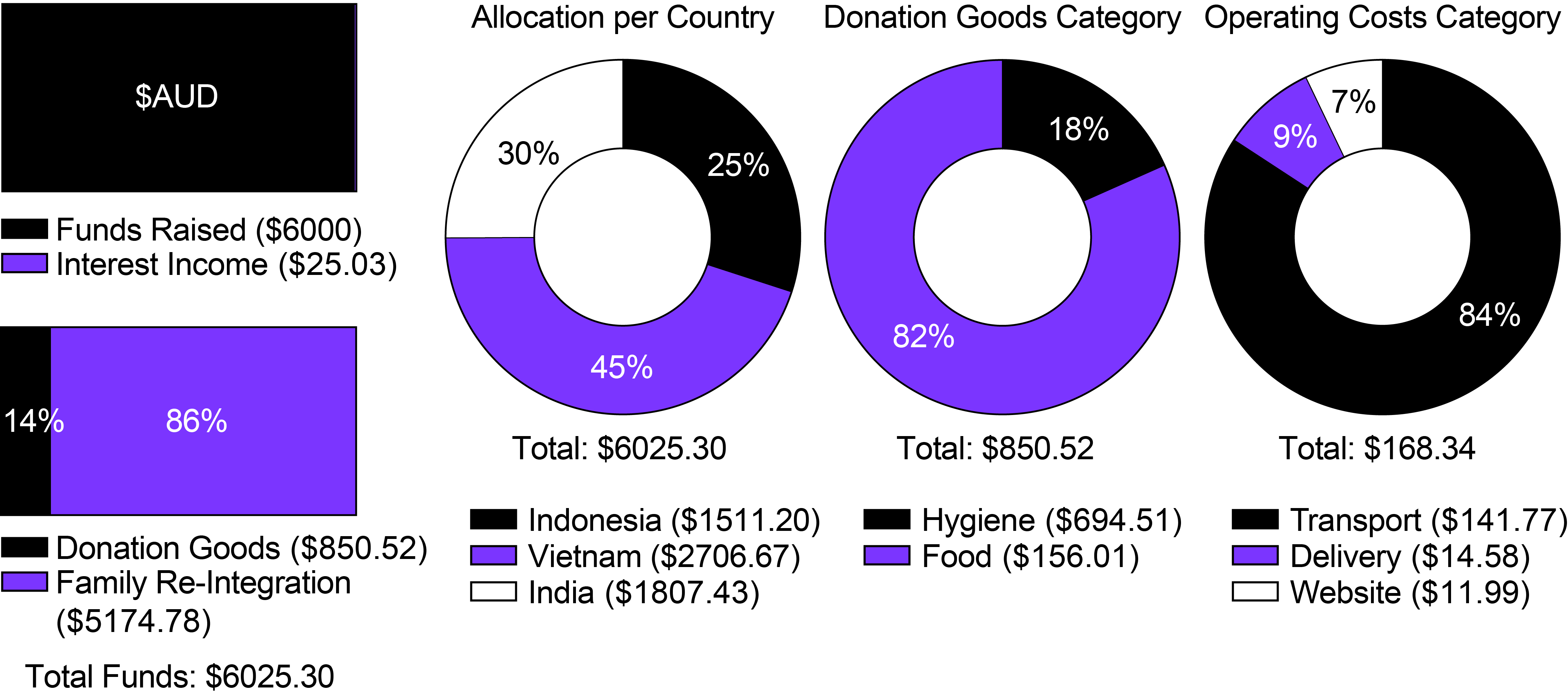
We pooled our capital to raise a fund of $6000. During the holding and dispensing period, we accrued $25.30 in interest, bringing the total available funds to $6025.30.
Our admin/operation costs were intentionally not included as an expense to our budget because we wanted the entirety of it to be allocated to supporting orphanages and children. We instead covered these costs ourselves. Operating costs totaled $168.34 with the majority occupied by transport to orphanages and markets for visitation and/or delivery of goods. An almost negligible amount was directed towards the acquisition of our domain address for the website ($11.99). In contrast, if we had instead used an existing website building platform rather than our Hugo approach, this would have cost an estimated annual 12-fold increase in costs ($144, WordPress Premium). If we were to assume that our budget was to accommodate these operating costs, it would only amount to a modest and favorable 2.81% of the budget.
The budget notably had no staff expenses, as our salary expenses are sustained by ongoing employment separate to this philanthropy project. In the future, we are adamant on been financially independent and will not draw a salary from the orphanage’s operations.
We deployed 86% ($5174.78) of our funds for programs that aimed to re-integrate non-orphan children back into their families through both direct and indirect means. The remaining 14% ($850.52) was spent on requested donation goods. Of these goods, 82% ($694.51) were food items while 18% ($156.01) were hygiene-related items. Funding distribution varied across Indonesia (25%, $1511.20), Vietnam (45%, $2706.67), and India (30%, $1807.43). This uneven split wasn’t intentional – it was more of a reflection of the underestimation of the time required to run this project. Case in point: we spent no funds on donation goods for India-based orphanages but instead allocated funding only to the family re-integration strategy.
What did we learn from this budget?
- Family re-integration programs provided a more scalable approach to fund disbursement. We could readily deploy funds to existing programs because an interview with the program managers was sufficient to judge the program quality and whether it aligned with our values. Contrast this with only a one-person team on-the-ground organizing the logistics and acquisition of donation goods, making it far less efficient. Separately, this approach was independent of time-sensitivity and geography – we communicated and organized funding for Snehalaya over emails and online meetings in a region of India that was outside of our visit region (Bangalore) and on-the-ground period.
- Exploiting the currency purchasing power differential allowed us to maximize the impact of our funds. By earning income (and hopefully later revenue through entrepreneurial pursuits) in nations with strong currencies and disbursing funds in regions with weaker currencies, we could stretch our budget further. This is one reason why our operating costs could theoretically remain a minor proportion of the total budget.
- You can dramatically cut down costs by exploring non-obvious and non-standard paths. We demonstrated this by building our website using the open-source Hugo framework rather than utilizing the more common approach of existing website building services.
- We also utilized a payment method (Ubank debit card) which incurred no overseas transaction fees or conversion fees, which further maximized our budget. While this option may not be available to all donors, understanding bank fee structures and utilizing the best options for card payments (e.g. Wise or Revolut) to provide the best currency conversion and low fees would be beneficial.
All our financial records are transparently recorded in the Budget.